Welcome to the Downloads area for the ‘Zebras and horses Event.
Click through to watch the video recordings of the presentations, and download the Companion materials: Slide decks, articles, and extra information.
Cheryl Long
Cheryl Long (Autistc therapist, social worker.Runs neuoraffirming Menopause Cafe)
Cheryl gives us an insight into autistic experience of the menopuase. She talks here about the what, why, and how hormonal experiences and transitions - such as the menopause - are differently impactful in autistic women (AFAB). Cheryl runs a menopause event for autistic people (details are in the companion booklet). In this interview, Cheryl discusses with Vauna what the new and established research reveals about this subject matter, and she also tells us her personal story of high-impact realisations relating to perimenopause and being autistic.
Vauna Beauvais. (Autistic person. Therapist, author and broadcaster, and trainer of neuroaffirming therapy).
Vauna establishes the intellectual and emotional foundation for our day's exploration of positive autistic identity and therapeutic approaches. It challenges conventional thinking about difference, adaptation, and what it means to thrive. Weaving together evolutionary biology, neuroscience, and lived experience to create ways of understanding the autistic experience, Vaunas session sets the stage for our subsequent workshops on assessment, identity work, life transitions, and authentic self-expression.
The first 3 presenters recordings are currently avialalble
as are associated materials provided by both the trainers, and by Vanguard Neurodiversity Training -
come back again as more is being uploaded soon.
To view the recordings, click the photograph of the presentation you want to watch.
If you would like to download the companion materials click the blue buttons below each presenters photograph and description.
Vauna Beauvais
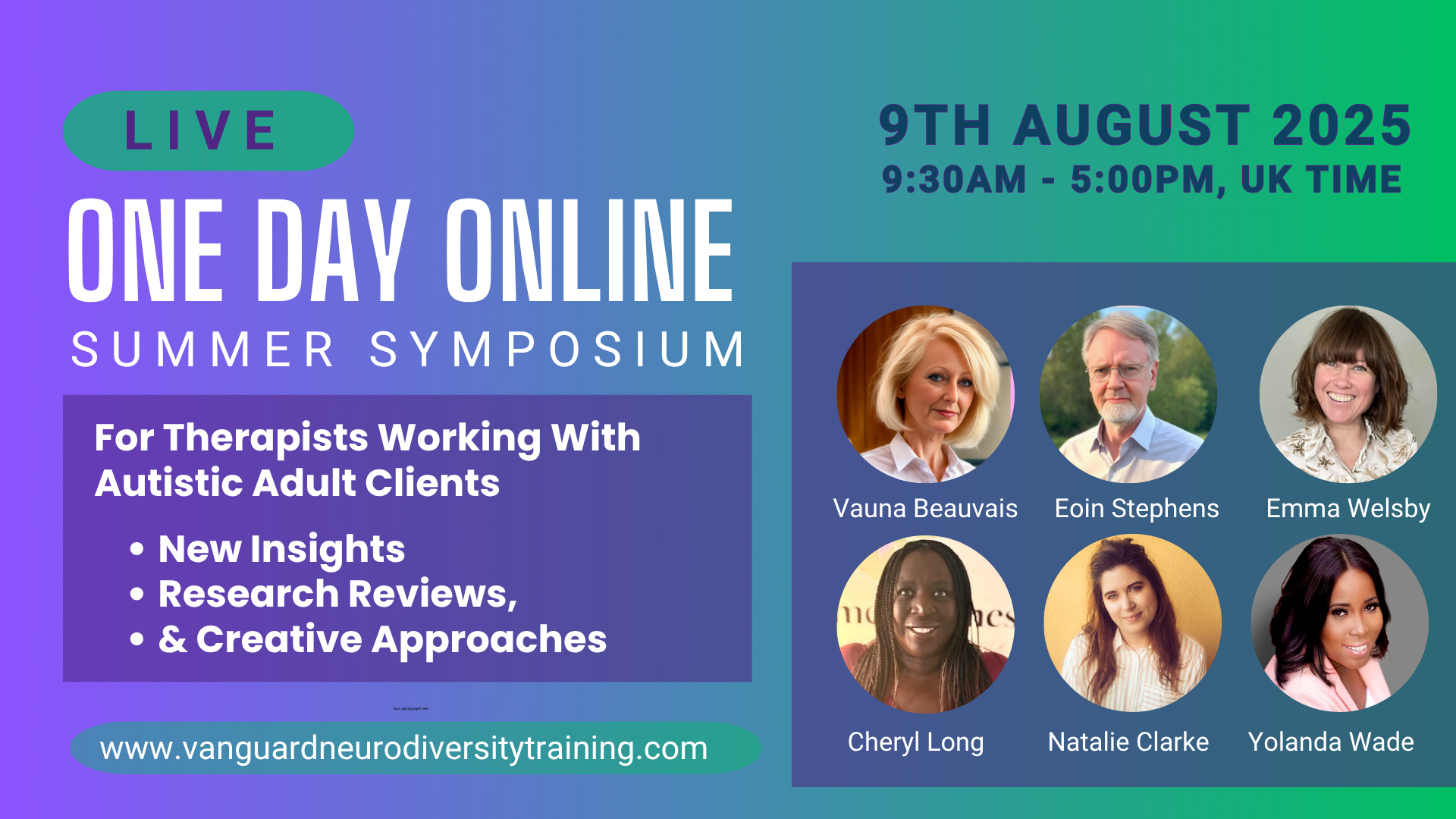
Emma Welsby
Emma Welsby (Qualified occupational therapist. Professional Autism Assessor doing Neuroaffirming Assessments).
Emma talks to us about the medical model ways of going about an assessment, and contrasts that with using a relational neuroaffirming assessment based on exploration, conversation and collaboration. Emma gives facts about the standard autism assessment tools. She illustrates from her work the ways that being a neuroaffirming practitioner makes so much of a difference in the quality of experience at such an important time in a late-identifying autistic persons life. See the booklet for how to contact Emma.